


“Something has gone wrong in England”
The beginning of Dear England, written by James Graham and directed by Rupert Goold, is quite possibly the best show opening I have ever seen, taking audience members directly into the mind of Gareth Southgate (Joseph Fiennes) as he replays the moment he lost the Euros for England in 1996 on a penalty shootout. A halo of light, designed by Set Designer Es Devlin, rises up, setting the stage in an intense Wembley Stadium, with the turntable allowing an older Southgate to relive his past mistakes (with his past self being played by Will Close). It is a fantastic start to the show that emphasis the way Southgate is unable to escape his past, even when he is about to become the interim manager for England.
The majority of Dear England focuses on a question Southgate asks not only himself and his team but the nation as a whole – what does it mean to “be England?” Indeed, Southgate asks many questions, typically letting his words trail off as he stairs out at the audience, an effective movement that forces the audience to think about his words and gives Southgate a distant and philosophical look that separates him from his sports-focused team. Fiennes does a brilliant job portraying the manager, contrasting his hope for the future of England with his inability to escape his own past with the team.
As someone who does not know too much about football in England outside of the rules of the game and whatever Ted Lasso has taught me, there were quite a few references that I did not understand, but this did not detract from my enjoyment of the play. It was a delight to see how audience members reacted to these references, including one man sittting near me who would grin a give a little nod of recognition each time something was referenced, nudging the woman next to him with excitement.

Dervla Kirwan plays Pippa Grange, the psychologist Southgate brings onto the team in a bold attempt to solve the problems England has been having. Grange is determined to solve the problem, which she believes to be fear, something rarely discussed in sports, particularly with men. Some other standout actors include Will Close as Harry Kane, Josh Barrow as Jordan Pickford and Griffin Stevens as Harry Maguire, each establishing their individual characters while also imitating the people they play (though I did not understand most of the references, the amount of laughter in the audience makes me believe they were fairly accurate). Close as Kane has some hilarious moments in which he talks very slowly, in a similar fashion to Southgate – the two seem to reflect one another up until the eerily similar end, with Close playing Southgate’s younger self in the opening scene. There is a heartbreaking moment in the second act featuring Denzel Baidoo as Bukayo Saka and how England reacts after the Euros 2020 loss (in a penalty shootout, no less), with Saka taking the brunt of the attacks. There is a feeling of claustrophobia as the fans close in around him, and it takes time and effort for him and the team to recover from the brutal loss and the effects it has on not only the team but the country as a whole.
After years of watching shows attempting to successfully incorporate videos into their shows, Dear England is the first where I actually think that the videos enhanced the production as a whole. Set Designer Es Devlin and Video Designer Ash J. Woodward have collaborated to create the perfect environment where it feels natural for videos to be playing on the screens, including a fantastic sequence where the coaches are analysing the players and their stats appear behind them. The visuals also work well for the moments in which football is being “played,” with Co-Movement Directors Ellen Kane and Hannes Langolf doing a brilliant job of creating rushes of energy and tension even without a ball on the “pitch.”

Unfortunately, the show struggles when it steps away from the game and instead attempts to make direct comments on the politics of England. There are several political figures that become caricatrues of themselves including Theresa May struggling with the turntable, Boris Johnson messing up his hair and Liz Truss appearing for just a few moments. While these characters are amusing, they really do not fit into Dear England, taking away from the serious conversations being had between the football team and the rest of England. That is not to say all the political moments are ineffective – a particularly inspiring moment involves the players talking about what the flag of England means to them, and it works because it directly involves the main characters.
The second act in general tends to drag, even with many events thrown in as the show gets closer and closer to reaching 2024. There is a section in which masks are worn and then removed once everyone is at a safe distance and later, Kane faces repercussions for wearing a political armband in Qatar, moments that felt a bit too recent to be portrayed on stage. Another moment that felt very rushed was one in which the Lionesses celebrate their Euros win, as it only lasts for the amount of time the audience applauds the win, with very little being added to the show by the scene. It would have been interesting to see more of a conversation between Southgate and Sarina Wiegman, the manager of the Lionesses.
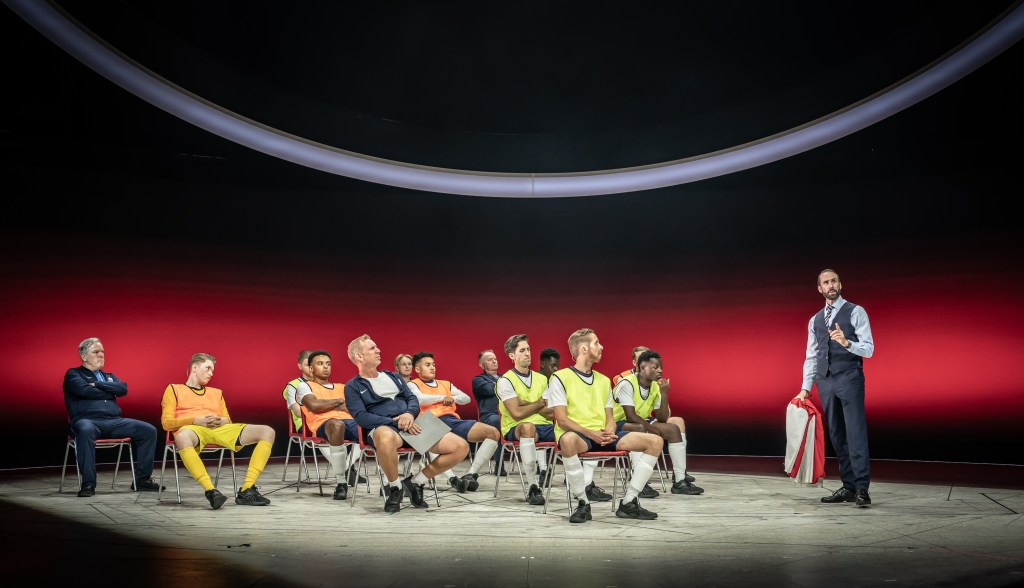
Ultimately, Dear England is a powerful play that brings the game of football to the stage, creating incredible moments of tension without a football in sight.
Dear England runs until 13 January at the Prince Edward Theatre on the West End in London. Tickets can be purchased here.
Photo Credit: Marc Brenner
 Little Lark of London
Leave a comment