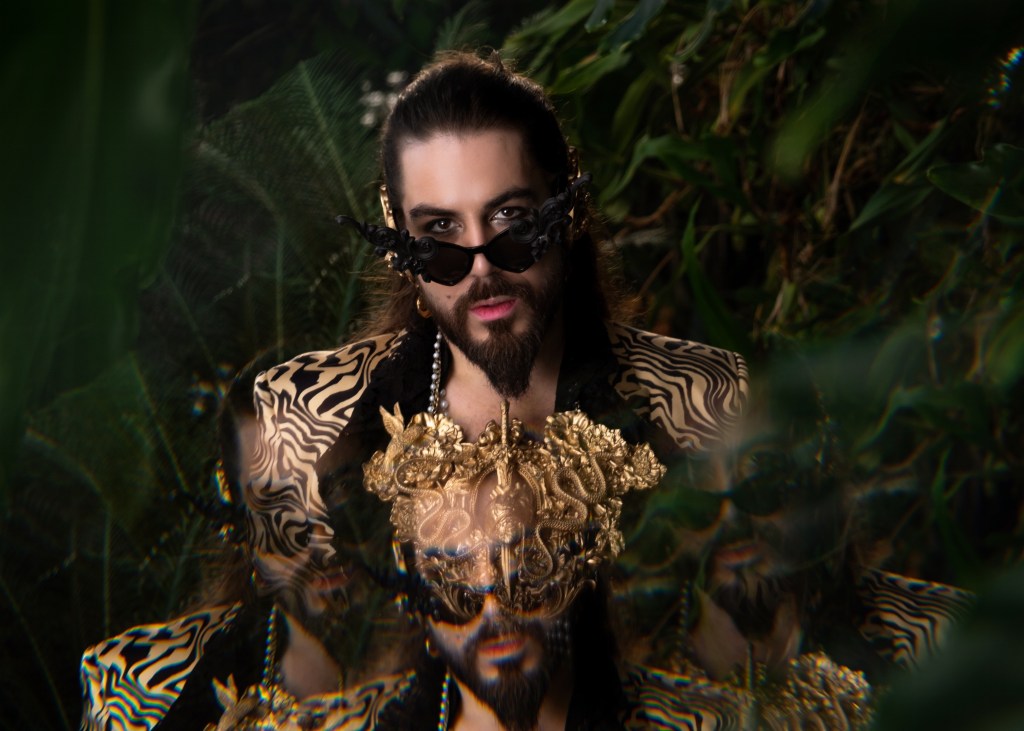
Bunburying (The Importance of Being Dr. Adam Perchard) – “part literary lecture, part rave, part confessional” – is Dr. Adam Perchard’s autobiographical show based on Oscar Wilde’s The Importance of Being Earnest. Recently, I had the opportunity to chat with Dr. Perchard about their show, which comes to London on Friday 1 March at Crazy Coqs. We discussed how they first got into the world of theatre, what they hope audiences take away from Burnburying and even what it was like being a host at a nightclub!
So if you’d like to start by telling us a bit about yourself and how you got into theatre?
Well, my name is Dr. Adam Perchard and I was into theatre from before I could walk – my first word was “More!” I used to sit at my highchair, banging my spoon on the table shouting “More, more more!” [Laughs] Which makes me sound like a horrifying Viking, Brian Blessed child, although I became much less butch than that because as soon as I could walk I put on a skirt and used to flounce around the garden, singing songs to make the flowers grow. So always quite a theatrical creature. But I didn’t really get into it professionally until I was a university lecturer. I used to teach English Literature at British universities and I had a nervous breakdown, which was the best thing that ever happened to me. Basically, my body just said, “Stop this! What you need to do is be onstage.” So I left the lecture hall for the music hall. And I got better – it was the place I was always meant to be. And the nice thing about Bunburying (The Importance of Being Dr. Adam Perchard) is that it’s kind of a fugue. On one level, it’s Oscar Wilde’s best loved comedy, The Importance of Being Earnest, I’m doing scenes from that. Interwoven with those scenes are scenes from my own life. And also little moments where it’s a literary lecture, as well. But also moments where I’m singing glam rock! That whole little mini journey of my life I just took you on is all present here in this show, which is why it’s so fun and healing to do – I love it.
And what was the creative process like for Bunburying, with so many different aspects of it being brought together?
It was wild! So my beloved Jersey Arts Centre, my local theatre in the tiny island of Jersey where I come from, they have been amazing. During lockdown, they basically saved me because singers were especially hated because we bellow and project all of our terrible microbes over the audience! [Laughs] I heard one study said the tenors were the worst, which I love – I’m a baritone. But the Jersey Arts Centre, this gorgeous theatre here, was commissioning me to make videos for them, then I did a solo show for them when we were only allowed 20 people in the whole theatre. I’ve come on a wonderful journey with them. I’ve made lots of solo shows starting there. And this time last year, it was a big anniversary for them, and they commissioned me to make a show. And Daniel Austin, the lovely Director, wanted me to do a one person Importance of Being Earnest. Fun for me, but I couldn’t help wonder if whether the audience would find it more fun if they had all of the members of cast!
[Laughs]
But I remember that the play was all about the masks that people wear in society. At one point, one character says, “This is no time for the shallow mask of manners!” And a lot of the play is about that. I started thinking about my queer and non-binary journey through the world. Previously, I wrote a play with some wonderful trans friends, and we were also talking about masks and passing and authenticity. It felt like there was a big conversation to be had in conjunction with Wilde’s play. And one of the reasons it’s still one of the most popular comedies ever written is that it feels incredibly relevant to our present moment – all of these characters could still exist today. Even a lot of the battles that Wilde went through, being punished for his sexuality, that’s still going on. So that’s the reason for the interweaving and weirdly, it came together very easily. I thought about it for a really long time and then suddenly it just slotted into place – this story, this story, this scene, this song. Gotta have some Patti Smith in the middle there!
So had you been a fan of Wilde before?
Oh, I love Wilde! My favourite things as a child were his children’s stories. They’re so beautiful and so, so sad. My dad, who’s a very soft-hearted, lovely man, had to stop reading them to me in the end because he would just become so choked up! But they were gorgeous. And I was a slightly morbid child and I loved them. And then I went to university at Oxford. I had wanted to go to art school, but my mother and father were determined I should go there and they took me around all of the colleges and I met many of the Heads of English and they were all these fusty, dusty, crusty, old cis white men, and I just thought, “Get me out of here!” And then we went to Brasenose College and the Head of English was this incredible woman called Sos Eltis, and in my memory, she ran across the college lawn, barefoot, and jumped over the “Don’t step on the grass” sign. She was a specialist in Oscar Wilde, and she was exciting, and she was just brilliant. And then it turned out that Oscar Wilde had studied with Walter Pater at Brasenose. He was mainly at Magdalen down the road, but he used to come for lessons there. So it meant that Wilde and I spent some of our formative moments in the same dusty golden rooms at Oxford, which is amazing!
I didn’t know he wrote children’s children’s stories. That’s interesting!
They’re fabulous! So sad, but they’re so beautiful. There’s one about a beautiful statue of a prince made of gold and he’s full of jewels, and one by one, he gives all of his jewels away to little birds. And they keep on asking and asking and then in the end, he gives them both of his eyes, so he’s blind and he’s alone. And then one bird loves him and stays with him, but then dies! Very sad. There’s also a nightingale who hears a student really wants a red rose to give to a girl to say that she will love him, but there are only white roses. So the nightingale kills herself by pressing her bosom onto a thorn and dying the rose red with her blood. And then the student’s like, “Actually I don’t fancy this girl very much anyway,” and just throws the rose away! [Laughs] They’re brutal!
When you were at Oxford, you performed comedy with the Oxford Revue. What was that like?
I loved it! In my youth, I had been a child opera star in India, where I grew up. And I loved that. It was wonderful, but it was extremely serious. And I came back to to the UK and people made me be even more serious. And so by the time I got to university, that had all become a little bit of a drag! And so suddenly exploding into the comedy world was wonderful. I worked with some really wonderful people and started discovering that my strange little brain has quite a glittering, dark, surreal side to it. And I loved it! I ended up writing comedy for a long time. I was with Sex Shells, which was a queer quartet doing musical comedy. I discovered that in the end, you can say incredibly serious things through comedy. It’s a bit like having one of those old fashioned diving outfits with a bell over your head. You can walk through the deep, deep, dark waters of the world but you’re in your safe little bubble and you’re laughing. So it’s a way of touching the depths without becoming consumed by them. So I loved it! It was wonderful.
And you were also a nightclub host!
What a silly old bat I am! Yes, I was, whilst writing my PhD, which was all about Islamophobia and empire and structures of injustice in the world. So it felt really urgent for me to do and it felt very important, but it was also not the most uplifting because once you start looking for hatred, there’s so much of it. But whilst I was doing that, I was also working as a nightclub host! [Laughs] I was in a double act and we used to make ourselves wild out. We made an amazing outfit out of bubble wrap, where we were jellyfish, Elizabethan aliens. So we had bubble wrap, ruffs and puffed sleeves with lights hidden in them. I sang a song about lobsters! It was very different from what was going on in my academic life, but it was fabulous. I loved it. It couldn’t have couldn’t have gone on forever, because it was quite physically tiring, but it was a lot of fun!
It feels like mixing literature with comedy has been a theme throughout your life, and that works really well with The Importance of Being Earnest, right?
Oh, my God, it totally does! I’d spent so many years doing these completely different things, and I was just haunted by this mean old saying, “Jack of all trades and a master of none.” Although there’s a really good suffix to it . . .
“Better than being a master of one.”
Yes, that’s it! That was nice and redemptive when I learned that. But it certainly has felt over the last few years, and particularly with this show, that all of these disparate fragments are joining up. So this show was commissioned by the Jersey Arts Centre last January and then the other outing that it had was I took it to Svalbard in the Arctic, which is the northern most theatre in the world!
What made you what made you go there?
I was invited for the Northernmost Literature Festival in the World. It’s great! Everything there is the northernmost in the world. I got there and had a burger with an egg and the egg squirted down my lapel, and my friend who was there with me said, “Oh, that’s the northernmost stained lapel in the world!” [Laughs] So I was invited to the Longyearbyen Literature Festival, which was amazing. And it’s a testament to Oscar Wilde how brilliantly it worked, because it’s an interesting mix of people. There are lots of scientists that are out there researching. There are also quite a lot of hardy, Norwegian fishermen. And there was quite a butch atmosphere in parts of the room, which I’m not always used to in my theatres! And so I went out and there were moments when some of the first Oscar Wilde characters I did didn’t quite land, and then I did Lady Bracknell, the famous battleaxe who says, “A handbag?”And at that point, the Norwegian fishermen were like, “Yes, we got it. We love it! Give us your big shouty posh lady!” So it was gorgeous.
And then afterwards, this lovely older woman was waiting for me outside and she said, “You were using this word ‘queer’ a lot in your show. Is queer a word that women can use too? and I said “Yes, of course!” And she said. “Oh good! Because I am what they call here a ‘tractor lesbian,’ because I dress like a tractor.” [Laughs] And she did! It’s a weird thing. But actually, when I looked at her, she did dress like a tractor! And I discovered later that’s a Nordic thing. So I said, “I’ll tell you what. I’m going to leave ‘queer woman’ here with you, and in turn, I’m going to take ‘tractor lesbian’ with me and try and make that happen!”
[Laughs] What do you hope audiences take away from Bunburying?
It’s a really interesting one, this show, because my audiences are normally quite diverse in terms of everything – age, demographic, all that. But this particularly tends to attract two distinct sort of audiences. You get often the older audiences, the straight audiences who come for the Wilde, and the younger queer audiences that come for the wildness. And I feel it’s very special to take them both on the same journey through Wilde and through my life. I hope that they end up at the same destination, both of them. For the younger audiences, people that are not so familiar with Wilde, I hope that they discover how far our lives reflect in him even today, and how he can be a friend to us if you’re in need of someone to read and connect with. But all the way through, it’s been to do with queerness, and the final act of the show is thinking about trans rights. And thinking about how the title, Bunburying, comes from a character in Wildes’s play who calls it “bunburying” because he’s got a pretend friend who’s always ill in the country called Bunbury, so that he can run off and pretend to be a different person. And in the end I talk about how all of this moral panic about trans people comes to do with this idea that they are just wearing masks – that they’re a man pretending to be a woman lurking in the bathroom. Whereas in fact, the opposite is completely true, and what we need to do is try and stop trans people from from being forced to wear masks and allow them to just be authentic and free. I want to leave people having had this empathetic journey, going out into the world with more empathy into their hearts.
And finally, how would you describe Bunburying in one word?
Dazzling!
Bunburying runs on 1 March at Crazy Coqs. Tickets can be purchased here.
Photo Credit: Wayne Stewart at Eric Young Orchid Foundation
 Little Lark of London
Leave a comment