
“Time will change”
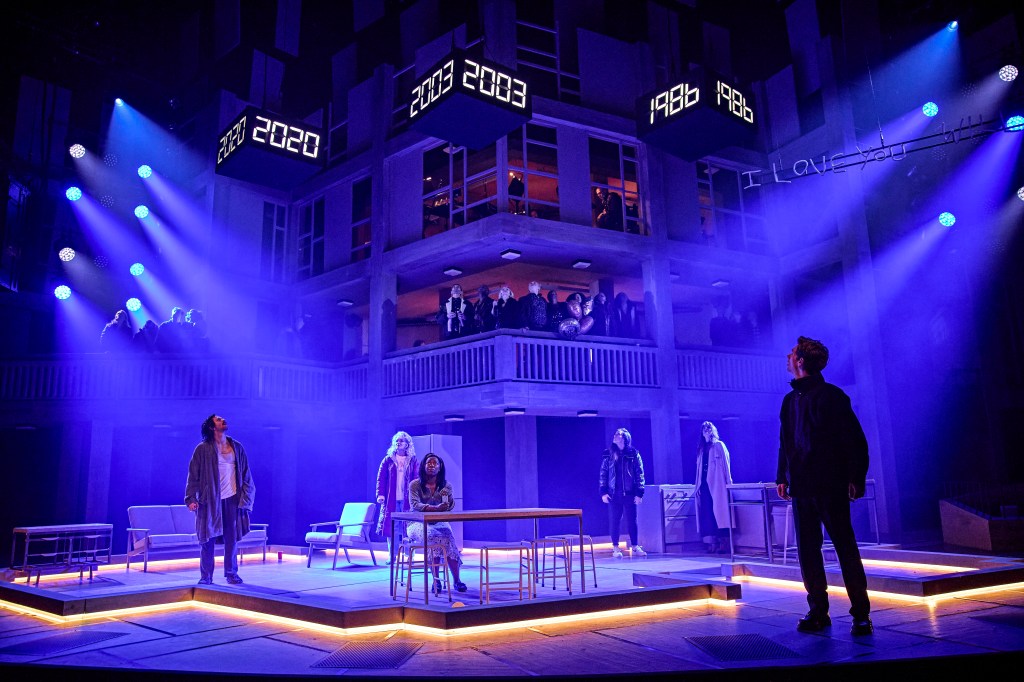
Written by Chris Bush with music and lyrics by Richard Hawley, Standing at the Sky’s Edge tells stories from Park Hill, the famous estate in Sheffield. The audience witnesses three stories taking place in the same flat, with the timeling switching between three time periods – the 1960s/70s, the 1980s/90s and the 2010s/20s, indicated by three floating platforms with the years on them depending on which story we are focusing on. Set designer Ben Stones has done a fantastic job in transforming the Gillian Lynne Theatre into Park Hill – even as someone with a strong dislike for Brutalism, I managed to find great beauty in the set and the role the building plays throughout the show.
The cast do a wonderful job switching between the three different time periods, changing costumes (designed by Ben Stones) and attitudes depending on when they are in Park Hill’s story. The first main couple of the story, Rose (Rachael Wooding) and Harry (Joel Harper-Jackson), are the first to move into the Park Hill flat, seeing it as a new opportunity to start a family and live a happy life. Wooding steals the show as Rose, a heartbroken yet powerful woman who must deal with her husband falling into depression as the steel industry declines under Thatcher.
The next family to move in is Grace (Sharlene Hector), George (Baker Mukasa) and Joy (Mya Fox-Scott), fleeing from Liberia. Joy, the cousin of Grace and George, has been separated from her parents, send to England for her own safety under the watchful eyes of her relatives. She longs to be free and finds some of the freedom in Jimmy (Samuel Jordan), the son of Rose and Harry, who continue to reside in Park Hill. Their relationship is beautiful yet bittersweet, as both feel trapped within Sheffield and are each other’s escape.
Finally, Poppy (Laura Pitt-Pulford) moves into the newly-gentrified Park Hill in the 2010s, escaping the life she was living in London and hoping, just like everyone else who lived in the flat, for a fresh start. Poppy and Nikki (Lauryn Redding) have the most frustrating relationship in the show, as Poppy is starting to truly find herself and then her abusive (for some reason made sympathetic?) ex Nikki shows up, even after Poppy rejected three marriage proposals with very good reason. Their relationship was the most frustrating aspect of the show for me because it depicts an abusive relationship in a good light, trying to make the audience sympathise with Nikki while questioning Poppy’s reasons for leaving her in the first place.
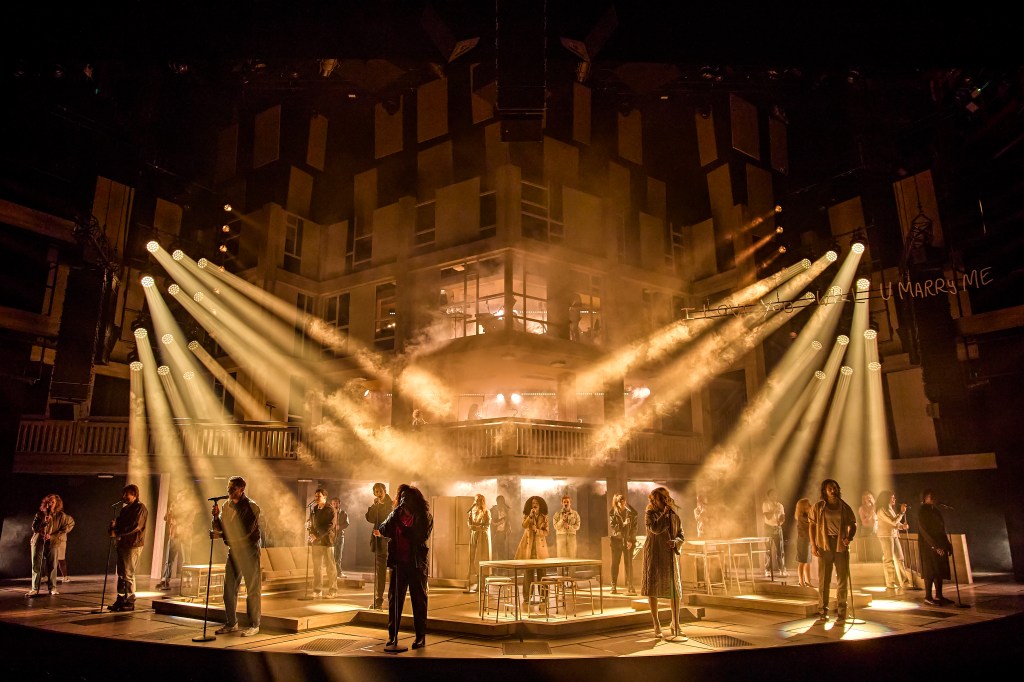
Unfortunately, while the show has a fascinating concept and stories themselves are interesting, I struggled to feel connected to any of the characters on stage. There are many moments that feel incredibly preachy, things that people would not say in real life, pulling the audience out of moments that could have been more powerful with more show and less tell. This is exemplified by the character of the narrator, who is unnecessary and takes away from the human aspects of the show, acting like some sort of guardian angel over the stories of Park Hill. The choreography (Lynne Page) is similar in that it works best in its simplicity, sometimes pushing too much and taking away from the music and interspersed dialogue. A strong focus on religion also grows a bit tiring at times, once again bringing repetition to a show that already has too much of it.
There are several choices that felt questionable throughout the show, the main one being how songs were simply placed in between scenes. Typically, in musicals, one sings when they no longer have the words to express what they are feeling, making for some incredibly powerful moments. Some great examples of this include “On My Own” from Les Misérables or, for a more modern reference, “Useful” from Operation Mincemeat. Unfortunately, Standing at the Sky’s Edge simply uses music as bookends, making it more of a play with music like the recent production of Brokeback Mountain, which I would certainly not classify as a musical. Hawley’s music is also quite repetitive, both in melodies and lyrics, which can grow quite frustrating when looking for development of any kind.
Another strange choice is made when it comes to performers going off the stage and into the audience. The performers only go into the audience once or twice throughout the show, a confusing choice that does not add much to the production itself. At one anxiety-inducing moment, cast members emerge in the audience, adding to the rage that is taking place on stage, but without warning, one might fear that protestors have come to stop the show.
Ultimately, Standing at the Sky’s Edge is a fascinating look into the world of Park Hill, but it struggles to find its place between a play and a musical, making for a confusing experience. The performers all do a great job, but they are failed by the choices made by the production.
Standing at the Sky’s Edge runs at the Gillian Lynne Theatre. Tickets can be purchased here.
Photo Credit: Brinkhoff-Moegenburg
 Little Lark of London
Leave a comment