

“The age of the green carnation was dead and gone”
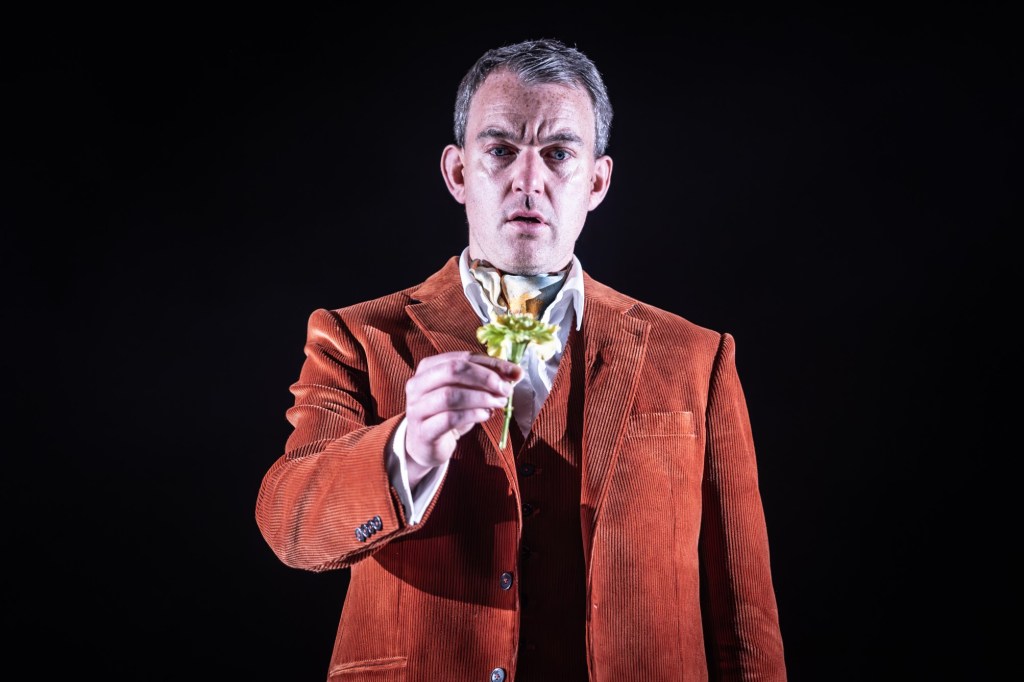
Written by Micheál Mac Liammóir, The Importance of Being Oscar examines the life of famed author Oscar Wilde in the form of a one man show. The play is a mix between excerpts from Wilde’s work and the actor speaking directly to the audience about Wilde’s life. In this production, directed by Michael Fentiman, Alastair Whatley takes the stage alone, performing for the camera as this particular performance was filmed specifically to be streamed online. After a brief voiceover from the show, Whatley begins with an introduction to the play itself. We are introduced to the green carnation, a flower that has become a representation of Wilde himself, a symbol of not only supporters of Wilde but homosexuality.
The set, designed by Madeleine Girling (who also designed Whatley’s costume) is simple, with a circle on the floor and one hanging above Whatley, almost as if he is in some kind of strange portal, frozen in a moment between the time of Wilde and our own time. The circles are both illuminated with white light, with lighting design by Chris Davey. There are only a few props including a lamp and a stool. In between each scene, music, composed by Barnaby Race, plays, with some more upbeat music playing during the happier times of Wilde’s life.
Whatley performs a range of excerpts from Wilde’s most famous works including An Ideal Husband, The Picture of Dorian Gray and The Importance of Being Earnest – with the iconic “handbag” scene as Whatley switches between Earnest and Lady Bracknell. Between each excerpt from works of Wilde, there are monologues to give the audience context as to what they are missing, with Whatley being fully aware of and directly addressing the audience. Along with his most famous stories, Whatley also reads some letters written by Wilde and even performs excerpts from his trial where he and Alfred Taylor were sentenced to imprisonment and hard labour for two years.
Unfortunately, while the concept is quite interesting, I found myself struggling to empathise with Wilde as a character with all of the switches from Whatley giving context to performing excerpts from Wilde’s work. When reading De Profundis, Wilde’s letter to Lord Alfred Douglas, Whatley is sitting on a stool, gazing into the darkness as he speaks. The letter itself is heartbreaking but I feel I would have connected more with it if Whatley had moved around the stage, maybe pacing back and forth as he is trapped in a cell of the Reading Gaol.
The ending, much like the end of Wilde’s life itself, is a sombre reflection on a short yet illustrious life that would go on to impact millions around the world. Wilde is “a derelict in the prime of life,” moving to Paris after being released from jail but still feeling tortured, as illustrated by his hatred for the magenta walls with him claiming that either he or the wallpaper must die. Unfortunately, it would be Wilde that passed away in that very place, with Whatley giving us Wilde’s heartbreaking last words to Robert Ross.
Ultimately, The Importance of Being Oscar is an interesting look into the life of Oscar Wilde, though it is mostly geared towards those who are already fans of the author based on how quickly the play jumps through his life. There are some powerful moments throughout, and Whatley does a fantastic job of not only portraying Wilde but a range of character, but more can be done to contrast the elegance of the first act with the darkness of the second.
The Importance of Being Oscar is screening online on Original Theatre. More information can be found here.
Photo Credit: Marc Brenner
 Little Lark of London
Leave a comment