
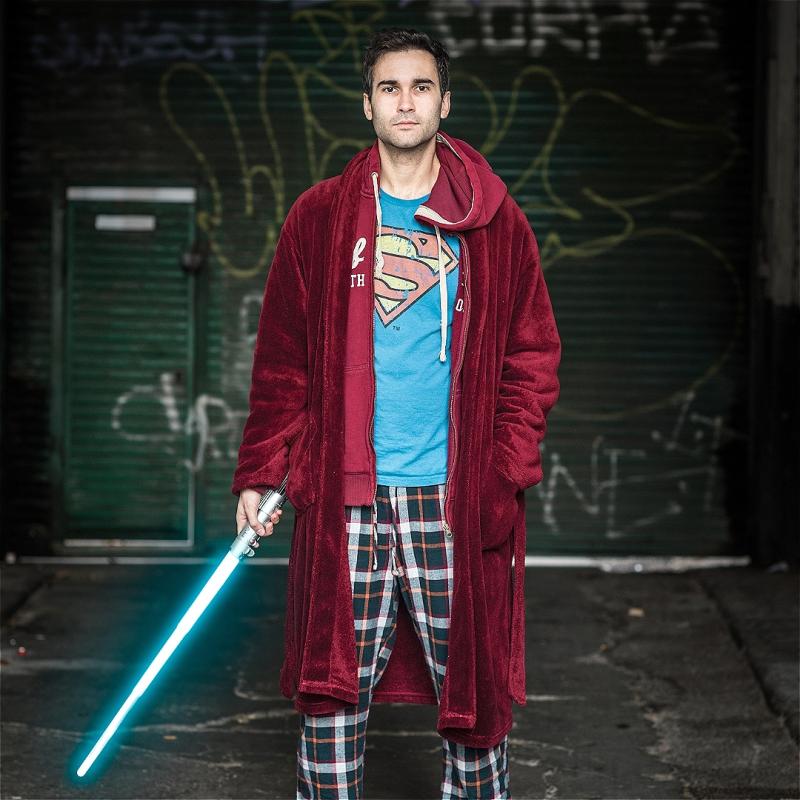
Walking into the theatre for Fanboy feels like you are entering the room of a young child in the 1990s – there’s a cabinet with an old television set, several VHS tapes scattered around and a cabinet full of memorabilia from a range of different franchises. Written and performed by Joe Sellman-Leava, Fanboy begins with an introduction to the titular “creature,” with Sellman-Leava narrating a short mockumentary with an impressive David Attenborough impression. He then enters the stage, dressed in a robe with the hood up, quickly whipping out his lightsaber (don’t worry, it’s not that kind of show!).
It is difficult to go into the plot of Fanboy without giving away too many spoilers, and, as Sellman-Leava expresses his dislike for them, I will do my best not to give too much away in this review. One of the main focuses of the show is Sellman-Leava’s love for the Star Wars franchise, particularly the prequels, as they came out during a formative time in his life and he connects them to happy memories of times with his loved ones and friends. But, as many people will relate to, Sellman-Leava is a fan of multiple things including Superman, The Muppet Christmas Carol and The West Wing, all of which are referenced to varying degrees throughout the show.
One of the highlights of the show is the way in which Sellman-Leava interacts with technology that has been seamlessly integrated into the plot of the story. The introduction to the use of technology in Fanboy is done subtly at first, with flickering television screens and “glitches” that have Sellman-Leava asking the person in the tech booth what is happening. Another highlight of Fanboy is its many, many references, which make the show quite fun for those who are in the same fandoms as Sellman-Leava and can appreciate even throwaway lines and references like one made about Jimmy Smits appearing in both The West Wing and Star Wars. His impressions are also spot-on, including a particularly fantastic reenactment of Obi-Wan and Anakin’s duel on Mustafar in Star Wars Episode III: Revenge of the Sith. But, even if you are less familiar with the different franchises in the show, there is enough of a separate plot that one can leave the show satisfied.
While the concept of Fanboy is quite interesting and the technical effects are impressive, there are quite a few times in which the script feels repetitive, with not much development of Sellman-Leava’s character happening until the final scenes of the show. There are also scenes that grow quite political, focusing on the fallout between Sellman-Leava and a former friend, which brings out a darker side of the show that might not have been expected. It should also be noted that this is the first time the show has been performed in a while, something that Sellman-Leava comments on after he has to ask the tech to read a section of the script out to him, having mixed up a few of the lines. The moment is quite actually meta, especially because Sellman-Leava actually has conversations with the tech that are scripted (or at least they appear to be!).
Ultimately, Fanboy is a sweet tribute to the joy of fan culture that gives audience members insight into the life of one of the millions of fanboys around the world. Sellman-Leava uses a mix of technology and script to make for a fascinating reflection on not only his past but what could become of him in the future, leaving the audience thinking about their own lives and relationships with the things they love.
Fanboy ran from 14 to 16 October at Pleasance London.
 Little Lark of London
Leave a comment