

“It’s an incredible opportunity to play such a complicated, contradictory character who makes some extremely bold and brave choices amidst her oppression”
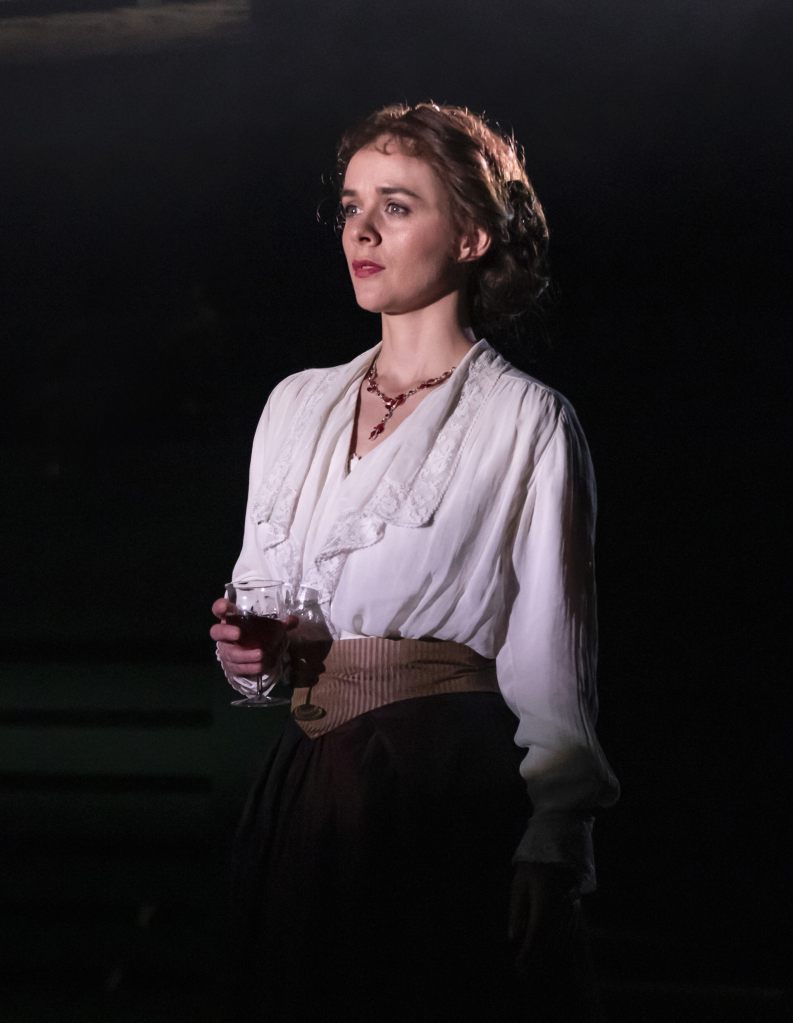
Birdsong, Rachel Wagstaff’s stage version of the Sebastian Faulks novel of the same name, tells the story of Stephen Wraysford, a lieutenant in the British Army in World War I, and the relationship he has with Isabelle Azaire, a married woman living in Amiens, France. Set both before and during the First World War, Birdsong explores just how far people will go for love through “an all-consuming love affair” and “the horrors of the First World War.”
Recently, I had the chance to speak with Charlie Russell, who plays Isabelle in Birdsong. We discussed how she was first introduced to Birdsong, what the work means to her and what it has been like to take on a more serious role after many comedic roles with Mischief Theatre.
So starting with a bit of a general question, how did you first get started in the world of theatre?
My first introduction to theatre was as a very young child. I remember sitting in an audience in a small room in Grange-Over-Sands in the Lake District and watching my mum in amateur dramatics. I think she was dressed as some kind of Greek goddess, and ever since then, I was fascinated by it. It really was thanks to my mum! She would bring me along to the local play readings of her amateur dramatics group and it was there that I got involved in the local amateur pantomime. My first-ever role was a fairy in Geppetto’s workshop, a fairy doll. And that’s really where it all began – amateur dramatics and through school and watching people do it live – that was really my introduction.
And so what made you want to be a part of Birdsong?
When I got the audition through, I remembered I had watched the BBC adaptation with Eddie Redmayne. As a teenager, I’d watched it with my dad, which, if you know the story, was a pretty awkward experience at the time! But it’s my dad’s favourite book, so this all rang loads of bells for me, and I remember really loving the series. So then when I got to read Rachel Wagstaff’s script, I was hooked! [I was] very excited to get the opportunity to audition for the role of Isabelle in the room with Alastair [Whatley, Director], Bethany [West, Associate Director] and Rachel, and then getting to meet James Esler, who plays Stephen, in the auditions, that really sold it for me – the people, the level of commitment and talent was very exciting.
So you had seen the television series – had you read the book as well?
I’d only seen the TV adaptation. I hadn’t read the book yet. We got this message saying, “We’d like you to come to Sebastian’s house to read the new draft of the first act of the play.” And I thought, “Oh my gosh, this is incredible! If I haven’t read at least the first part of the book before I get to Sebastian Faulks’s house, who am I?” So I crammed that on every bus journey I could!
For those unfamiliar with the work, can you tell us a bit about it and the role you play?
The story is a beautiful and painful story of love and war. It follows the character Stephen Wraysford as a young man, around 1910, in Amiens when he goes to stay with a French family before the war. It’s there that he falls in love with the wife of the person he’s working for and they have an affair. I don’t want to give too much away! It then moves to World War One, leading up to the trenches, leading up to the Battle of the Somme. And then in Act Three, you see after the Battle of the Somme, just before the war ends. It’s an epic story of love and human resilience. You meet Jack Firebrace, who is an incredible character, a sapper, one of the people who built the tunnels under the trenches during World War One, which was integral to the war on the Western Front. I play Isabelle Azaire, the wife of the factory owner. She is much younger than her husband, happily the stepmother to his child, but she’s in a very loveless and abusive relationship. When Stephen arrives, he opens a door to a part of herself that she’d shut off a long time ago, a part of herself that might be brave enough to feel some joy, some love, some passion. It really shakes up her life and changes it irrevocably. It’s an incredible opportunity to play such a complicated, contradictory character who makes some extremely bold and brave choices amidst her oppression. It’s a real privilege to get to play her. I love it.
What is it like to be playing a more serious role like this compared to ones you’ve done in the past with companies like Mischief?
This question has come up a lot, which I completely understand – I’m interested in it myself! [Laughs] It’s been brilliant and I am very keen to do more of it in the future. It’s really exciting to find what’s different about acting when you’re playing a much more serious role, the kind of work that goes in, but it’s also been really interesting to find out what is similar. Some people say that comedy actors make good dramatic actors because the skills that are required to do comedy are the same ones needed to play a serious role. In my opinion, in order to do comedy well, you approach it truthfully with commitment and specificity, and I feel like it’s actually the same when you’re playing a dramatic role. You might say it’s the same muscles, just used in slightly different ways – they are still the same muscles that you’ve been building through your training and experience. And actually, the commitment and discipline it takes to keep a straight face in a very serious moment and choose to play a comedy moment truthfully is the same level of rigour and discipline you need to approach a serious role, and I’ve loved finding that out. Obviously, physically, it’s slightly different from the work I’d been doing before, although you’d be surprised – I still managed to get loads of bruises! It’s just now, I can’t blame anybody else for it. It’s just me bumping into the set!
And what has it been like bringing this show on tour?
Oh, it’s been really fun taking Birdsong on tour! We’ve been to some really cool cities and towns and have had wonderful receptions everywhere we go, which has been delightful. It’s been a privilege as an actor to go to all these different theatres and incredible regional venues, without which we wouldn’t really have the theatre scene that the UK has. I’ve really loved it. And getting to go to places that feel like hometowns . . . I have a lot of family who live in Leeds, for example, so that felt a bit like a homecoming. I did some training in Cambridge when I was younger, so it was really great to go there again. And then some of these venues are places I went to all those years ago with The Play That Goes Wrong and some are completely new, so it’s really exciting! I’m very excited to go to Alexandra Palace in the spring, because I’ve never performed there, and I’ve always wanted to, so that coming at the end of the tour is a real highlight.
And so you recently read a poem selected by Sebastian, “After the Battle,” to celebrate Armistice Day. What was that experience like?
Terrifying! [Laughs] I was worried about my capacity to perform a poem. It’s been a while since I’ve done that, but Sebastian had chosen some really interesting poems for us to look at. That one [“After the Battle”] really spoke to me, because something I’ve been thinking about as we do this play is the futility of war, which is sadly even more poignant at the moment – the way that wars are waged by people who don’t do the fighting themselves. And so that poem felt very special to me and I felt glad to be able to perform it and bring it to people who hadn’t seen it before.
Do you have any favourite lines from Birdsong?
I have different favourite lines for different reasons! One of my favourite lines is from a character called Captain Gray, who is suggesting to Stephen Wraysford that he go into the town for some racy “R and R.” He says, “I hear there’s a peasant woman and her daughter who can see a whole battalion in a week.” And then he says, “Remarkable people, the French.” That character is saucy! [Laughs] And then Bérard has a line early on – I like this line for a different reason – Bérard says, “Did you know they’re developing guns in America that fire all by themselves? Now that is something I would like to see.” I find that line really poignant because it clearly comes from a person who has such privilege that the idea of an automatic gun doesn’t frighten him – it excites him. That’s really interesting coming right at the beginning of the play with so much foreshadowing.
But my favourite personal line is Isabelle’s. It’s after the scene that we have in the show that is called “The Red Room.” It’s famous if you’ve read the book – it’s the moment where Stephen and Isabelle have sex and get to express their passion and love for each other. And at the end, Isabelle says, “I am finally myself.” I really love that, because it’s a wonderful moment where we get to portray sex as a positive thing and a liberating thing – a liberating thing for a woman. And then she gets to express that. Throughout that empowering, passionate time, she’s closer to herself than she’s ever been. And it’s just so nice. We so rarely see such positive portrayals of sexuality and sex for women in stories. It’s just such a lovely moment.
It’s surprising to see that in a play about World War I of all things, right?
Yeah, and that’s the thing we’ve been talking about with this play! In the war, in the trenches, in the Somme, it’s graphic, grotesque, blood, guts, limbs, flesh. But of course, on the other side of that, human passion and love is the same. There’s bodily fluids and flesh and limbs and skin, but it can be liberating and beautiful, and it’s just how we treat other humans that dictate what kind of experience it’s going to be.
What do you hope audiences take away from Birdsong?
I hope that audiences have come on the journey with us, that they feel connected to Stephen and, like us, feel connected to the real people who did actually lose their lives, who were unprepared and unsupported for the horrors of war. We all feel quite honoured that we get to tell their stories. It’s the only way we, as actors, can make a difference like that, and I hope the audience get to feel that too. By coming along, they’re doing the very same thing, and maybe they’ll feel uplifted. There might be some hope that’s certainly moved by all the portrayals of love in its different forms. It’s a beautiful night at the theatre.
And finally, how would you describe Birdsong in one word?
Epic, definitely epic. And when we go to Alexandra Palace in the spring, it’s going to be an excellent amalgamation of an epic play, epic performers, epic writing, epic set/costume direction, in an epic setting!
Birdsong runs at Theatre Royal Newcastle from 21 to 25 January, Birmingham Rep from 27 January to 1 February, Theatre Royal Brighton from 4 to 8 February, Aylesbury Waterside Theatre from 11 to 15 February, His Majesty’s Theatre in Aberdeen from 18 to 22 February and Alexandra Palace Theatre in London from 27 February to 8 March. For more information and to purchase tickets, click here.
 Little Lark of London
Leave a comment