

“When you’re part of something that’s bigger than yourself, it feels like an honour to be involved with that.”
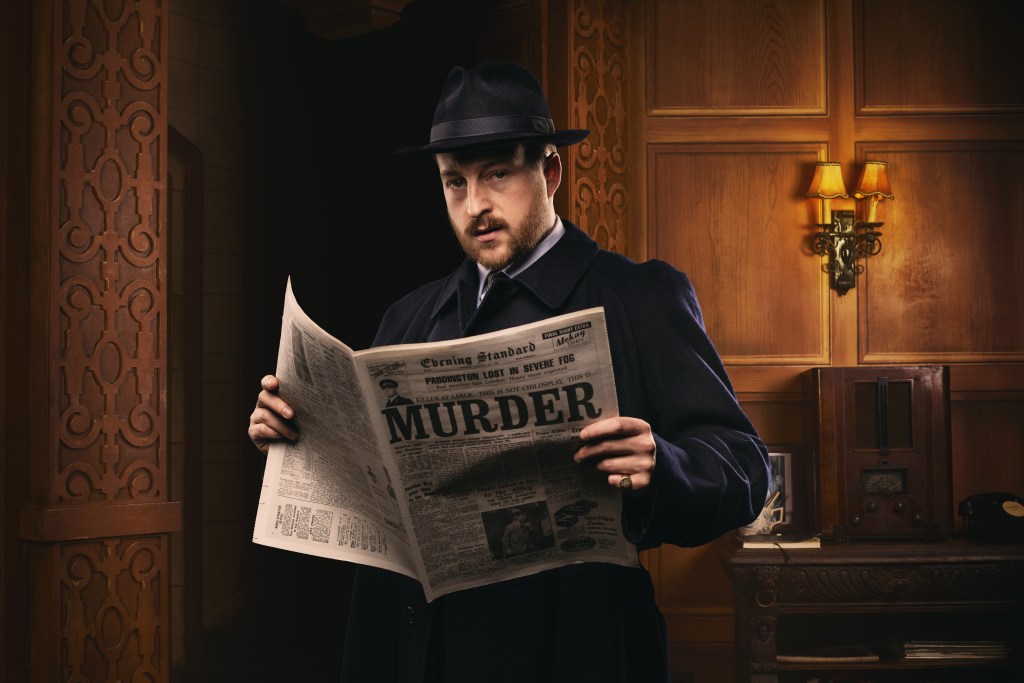
Agatha Christie’s The Mousetrap has been on the West End for over seven decades, earning the title of “the world’s longest running play.” For years, audiences have flocked to Monkswell Manor to see if they can solve the mystery of . . . Whodunnit?
Recently, I had the chance to speak with Harry Bradley, who plays Giles Ralston, husband to Mollie Ralston and new owner of Monkswell Manor. We discussed
All right, so starting with a bit of a general question, how did you first get started in the world of theatre?
Well, I didn’t always want to be an actor! I did some theatre and ran the film club when I was at school, and had a lovely time doing it, but always behind-the-scenes stuff – making films, directing plays, that kind of thing. And then I remember being in English class, and I was mucking like I normally was, being cheeky, and my teacher was like, “Okay, that’s it! You’re going to be in a play because I think it would be good for you.” [Laughs] So they did Alice in Wonderland, and I was one of the gardeners painting the roses red. That’s how it started!
So it started as a punishment! [Laughs]
As a punishment! As an “Okay, if you think you’re gonna muck around in my class . . .” And, to be fair, in a comedy role. Shoutout to Miss Otaki – she knew what she was doing! Long story short, I didn’t pursue it when I left school. I did a degree in something else because I always wanted to be in the business, but never thought acting was possible for me. I was quite shy and never thought it was a thing. Then I went to Nottingham University and did a lot of student drama. There’s an amazing student drama department at Nottingham, which is all just student-run with a 100-seater auditorium, and everything is brilliant. So put on loads and loads of plays!
And then, consequently, with my degree, I did a year abroad in America – I lived in upstate New York for a year. While I was there, I did a Neil LaBute play, Reasons to Be Pretty, which is a great play – I was playing an all-American, working-class guy. The director was a visiting professor, an actor and director the university got to direct the play. His name was Wesley Broulik, a really cool guy. At the end of the run, he took me aside and said, “I think you should do this professionally. I think you’ve got it. You’re good enough to think about this as a career.” And that was the first time that I was like, “Oh, okay, I actually love this!” Then I went to drama school and the rest is history! It wasn’t as simple as “I was in the nativity play at six, and all I wanted to be was an actor ever since.” It’s taken people believing in me and giving me chances for me to go, “Yeah, I like this!” [Laughs]
I do think you’re the first person to say they’ve started theatre as a punishment!
It was thrust upon me! I guess she was punishing me and thinking, “This might be good for you.” But yeah, I was being told, “I’m gonna put you in a play!”
And so what made you want to be a part of The Mousetrap?
Well, I’ve always been aware of it as this amazing, iconic thing. I didn’t really know the system about being seen to be in it. Although I’m pretty theatre savvy, I thought that it’s the same cast that’s been going – they only recast it every five years, maybe. But only recently it’s become every six months. Then, fortunately, Denise Silvey, who is the artistic director and casting director of The Mousetrap, came to see The Play That Goes Wrong and I was on – I think I was playing Max. I found out after the show that she’d been in and thought, “Hang on, that’d be lovely – another West End Show to go into if I could get seen for that!” So I emailed Denise and she was wonderful. She was like, “I loved The Play That Goes Wrong!” Coincidentally, considering that The Play That Goes Wrong has similarities with The Mousetrap in terms of being a murder mystery at heart and quintessentially British in its execution, Denise had never seen The Play That Goes Wrong. So she was like, “Oh, my God, there’s a funny version of our play down the road! What?” So that was lovely. And she gave me an audition, and I met her and Philip Franks, the director, and got on with them so well. And then after that, I was like, “Oh, I have to get this job!” The history side of it is so fascinating to me. As a theatre nerd myself, I just think it’s incredible. There’s nothing like it in the world, something that’s run that long. Although the play itself only moved into St Martin’s Theatre in 1974, it was next door at the Ambassadors before, but the history of it being in that area is just incredible. So I wanted to be a part of that fabric, another person that’s been part of it. When you’re part of something that’s bigger than yourself, it feels like an honour to be involved with that.
So for those unfamiliar with The Mousetrap, can you tell us a bit about it and the role you play?
Yeah, absolutely! I play Giles Ralston, and him and his wife Molly have just set up a guest house in a country manor in the countryside in Berkshire. It’s called Monkswell Manor, and Molly’s been left it in her aunt’s will. Instead of selling it, we decide to run it as a guest house! Rent the rooms and let people come – we’ll give them breakfast and lunch and dinner and what have you. So we have guests that come and arrive to stay, but they are all turning up with the knowledge that in London, only thirty miles away, there’s been a strangling – a woman’s been murdered. So the play starts to bubble with this danger afoot. And the other thing is we’re being snowed into the manor. The weather’s horrendous and everyone is trapped. The next thing you know, a police sergeant turns up to the manor to further his investigation about the murder in London. And consequently, all sorts of things start coming out about the guests’ past, my past, my wife’s past as it unravels into a classic, old murder mystery in what is a wonderful, classic British manor house setting with the snow pouring down outside the window. Agatha Christie is Agatha Christie – she needs no introduction! But it is genre-defining in it’s a murder mystery set in a country house – how many times has that been parodied or copied? I mean, I’ve been in a couple of productions myself that have parodied it! And so that’s the basic plot without saying too much – it’s what you would want from a murder mystery.
So what has it been like joining this iconic show?
It’s just been wonderful. It’s a quick turnaround! We had two and a half weeks rehearsal, which is pretty quick – maybe not the quickest I’ve had for a show, but quickest I’ve had for a show of that scale! But saying that, at no point did I feel unprepared or lacking in time. Always stressed and nervous because you’re opening a show to a capacity of 550 people! But the team is so wonderful and our director, Philip Franks, is so exquisitely intelligent and dedicated and passionate. He’s a Christie mega fan and a wonderful director and actor in his own right. So with his captaincy, it was just a joy. It’s a lovely group of people who really care about the integrity of the show and want to make it not just entertaining, but look into the the darker themes of it and play it as a real, scary, psychological thriller piece. Something we tried to avoid is leaning into the parodies of it that have come since. There is a parody version of the play that you could do, which isn’t what it is. Christie’s script is tight and exciting, and the character relationships are really dynamic. I mean, she’s one of the best writers of all time, and the script hasn’t changed in 73 years – it is as good as it is! And honestly, it’s way more than I thought it was. I thought it was this casual, twee murder mystery that’s happening all the time, but you look at it and it’s so much more than that. The characters are so fleshed out, with not much stage time in some cases. So joining that has been really cool. I love doing period stuff because you can research the time period and think about how your characters would think and feel and move, plotting all the backstories and everything. I love all of that. And it’s gone well so far, touch wood! [Laughs]
Had you seen The Mousetrap before joining it?
No, I’d never seen it! It’s one of those things like the London Eye, like “I’ll go and see it eventually. It’s always going to be there.” So I hadn’t seen it, but I’d worked with two people from the previous cast when I was on The Play That Goes Wrong, and I said, “I’m going to come and see you!” And then I got the job myself! [Laughs] But at the end of our rehearsal period, just before we opened, I went to go and see them, knowing that my version was already pretty set in my body and mind. And it was great! It was actually quite fascinating. There’s not many plays that you can go and see that you’re about to be in. I’ve done it twice now, which is strange! But it was quite fascinating to watch it on Friday night and then be in the cast on Monday night. And I think it speaks to how good the text is in that our version is actually quite different from the previous version in as much as it can be with the same characters and text. We’re all different actors with different styles, and I think that’s testament to Philip and Denise as well, who cast it – they’ve got different people giving different performances. It’s not just, “We’ll just do the same thing over and over again.” So that’s great, and it feels like you can really make it your own. I don’t know how many Giles there have been over the 73 years, but there’s a few, so knowing that I can still make my own version and make it different is really exciting. So I hadn’t seen it! But the problem is, I read the whole script when I auditioned, so I learned the secrets of the play by reading it in my bedroom, which is not ideal, but I still got the effect! I felt like I should know the ending when I auditioned. [Laughs]
So you were talking about making the character of Giles your own. How do you do that while still keeping to the principles of the character?
As actors, we’re always going to bring something of us to the character. So just that, in itself, in the way I move, in my inflections. The characters are fleshed out enough, but also, they’re not too descriptive in, “This is the way it has to be played,” and it’s certainly not what we’re directed as well. We’re encouraged to bring our own flavour to it. And again, kudos to Philip, who didn’t just say, “Oh, can you do it like that? Because so and so last time did it like that.” And it happens on The Play That Goes Wrong as well, actually. When I directed on The Play That Goes Wrong, you know where you want someone to get to, but it’s the lovely thing of letting them get there, almost letting them take the longer route to get to where you know they’re going to get to rather than give them the short route, because that doesn’t benefit you, it doesn’t benefit them. So that’s really exciting just to know that eventually, I’ve got to get to somewhere, but I’m finding my own way through and it is amazing. You’re given the lines, you think, “Okay, this is the way to say it,” and then seeing someone else do it . . . With my friend Dan [Cech-Lucas, the previous Giles Ralston], I was like, “Oh, he does it differently to me!” But that’s not wrong or right. It’s really exciting to think, “Oh, wow. Two people can have different ideas!” It’s how you chart the character. This play is really good because it’s an ensemble play. There’s so many relationships that you can be playing all the time. The weight of the relationships in relation to each other can then create a different character, a different Giles. It feels like there’s so many different combinations that can create a unique portrayal – I hope I’m giving a unique portrayal. We’ll see!
So what is it like performing in a show like The Mousetrap versus a parody of it like The Play That Goes Wrong?
It was quite bizarre at first! I mean, my track record . . . I did a UK tour of Cluedo, i.e. the board game, and then it became a comedy version on stage based on the American movie, Clue. So that was already the main Mousetrap parody, which I was in. And then I went on to The Play That Goes Wrong, which is another comedy parody of The Mousetrap, effectively, with its own unique setup in that it’s the play that goes wrong. So I was the Mousetrap parody guy for hire! [Laughs] And then I thought, “Well, I better go and do the real thing!” I did think, “Oh, this is going to be quite jarring,” because I thought I was going to be going into quite a dour version of what I’ve been doing – I can’t do pratfalls or looks to the audience, which is great fun. But there is actually way more wit in The Mousetrap than I first anticipated. When you put it in front of an audience, God do they laugh! It’s such a good script, because the first act really is a character comedy. There’s some awkward comedy with characters not liking each other.
And I think it’s interesting because you’re doing it in rehearsals, you think, “This bit obviously isn’t funny.” And then we’re doing quite a serious scene where I’m doing some shouty, serious acting, and the audience laughed at one point! I really wasn’t playing up, I promise! It’s fascinating, the response we get. You lull them into a sense of security with laughter and then as it gets more and more tense and palpable, people laugh out of awkwardness. People laugh when they’re scared. We’re not doing The Woman in Black, but there are points where people laugh like, “Oh, that’s scary! That’s not what we thought it was.” It’s a skill of the script and the writing – there are little pockets of humour all throughout the play. It gives such an entertaining evening for an audience, because it’s not an ITV drama murder mystery, nor is it a riotous comedy. It’s got both, which is really cool.
So basically, I’ve been able to use my expertise of comedy murder mysteries, and I love it! [Laugh] I love comedy and I love clowning, and I think clowning and comedy can teach you so much about the whole spectrum of acting. It’s the best acting class because most people in the comedy don’t know they’re in a comedy. They think they’re in a tragedy. That was a big thing on The Play That Goes Wrong. The character of Chris Bean, the put-upon director, is just desperately trying to get this play moving along. He is in the biggest tragedy of his life, but the audience find it absolutely hilarious. So clowning and comedy for that sense is wonderful actor training, and I encourage actors to do it as much as possible because you have to know what it’s like to be a tragic hero in a comedy. And then it helps in The Mousetrap. I don’t think I’m quite a tragic hero in Mousetrap. It’s not Oedipus or anything, but it’s there, so it’s been amazingly helpful. What is quite confusing is The Mousetrap’s set is quite similar to The Play That Goes Wrong’s set, so at first, that was quite hard to get my head around! But I didn’t fall over or shoot out of an elevator or anything at any point!
How have the shows been going so far?
It’s been great! We do nine shows a week, every week, which is busy. It was coming off the back of two and a half weeks rehearsal. Although, we had two days off before we opened, which was bizarre, because it’s a working theatre – the previous cast had to finish the show. So that was quite strange, and then we just opened! But it’s been great. I’m finding new things and being able to play still, and I feel comfortable with it – touch wood – and it’s a great team who make you want to be better every time you go on stage. People are raising the bar – they’re really listening and engaged and really care about the work. So it’s just a pleasure to be there every day. And I get a nice cardigan as Giles, it’s a lovely Act Two costume – it’s quite comfortable! There’s a lot of comfortable places to sit backstage, which helps!
Do you have a favourite non-spoiler line in the show?
At one point I call someone an idiot, which is just really enjoyable to say, because it’s just me on stage at that point, and I get to really enunciate “idiot,” which is very fun. I do say one thing about the same character, actually! “He’s probably one of these young men that go about bilking hotel keepers,” which is lovely. It just feels quite quaint, twee. There’s a lot of lovely language that we don’t use anymore, obviously, because the play is set in 1952. Things like, “Pretty good, what?” People used to say “what” on the end of sentences just to denote, “Yes?” Things like that, archaic kind of mannerisms, I love so much.
Finally, how would you describe The Mousetrap in one word?
Thrilling. I think that speaks to both the laughter and the intensity. Thrilling!
The Mousetrap is currently running at St. Martin’s Theatre with tickets available through September 2025. For more information and to purchase tickets, click here.
 Little Lark of London
Leave a comment