
“You can’t repeat the past”
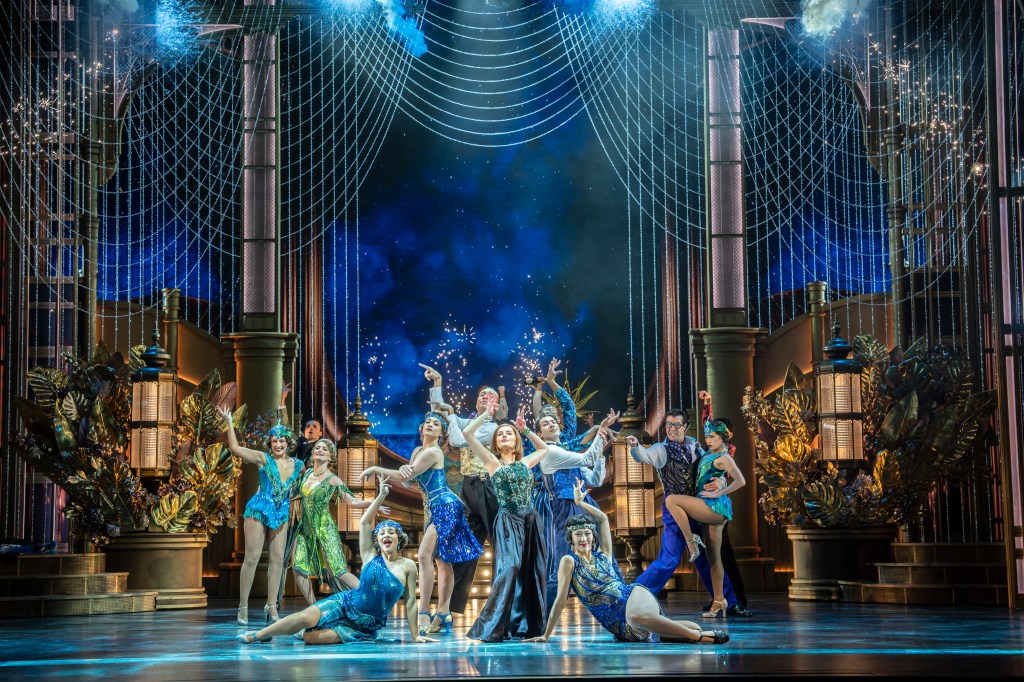
100 years after it was first published, F. Scott Fitzgerald’s The Great Gatsby is making a splash in London, now as a musical at the London Coliseum. The work is narrated by Nick Carraway (Corbin Bleu) as he tells the story of his neighbour, the rich and mysterious Jay Gatsby (Jamie Muscato) and the rise and fall of the Jazz Age in America. It’s one of the most beloved novels in American history for good reason, and it makes sense that creatives would want to capitalise upon its fame in adapting it.
This particular adaptation was created in 2023, with music and lyrics by Jason Howland and Nathan Tysen and a book by Kait Kerrigan. It opened on Broadway in 2024 and has been playing there since. It is certainly an interesting choice to have the show come to the West End after receiving mixed reviews on Broadway, mostly gaining fame through its original star leads of Jeremy Jordan and Noblezada and later social media infamy through Ryan McCartan putting a hex on audience members for laughing and several memeable moments in the show itself.
With a musical based on such a well-written and enchanting work like The Great Gatsby, one would expect a complicated show that pulls the audience into the world of the 1920s, looking at the complex issues of class difference and gender roles. Instead, this production of The Great Gatsby has basic and repetitive lyrics, and the dialogue is expository at best, telling and not showing the audience what they need to know. It’s frustrating to watch, especially with the fantastic source material that the creative team is working with. Even the potentially queer aspects of the novel are explicitly removed, taking the characters of Nick Carraway and Jordan Baker (Amber Davies) and pairing them together to tie up any loose ends. Credit must be given to Jason Howland, however, who wrote the music – I still find myself humming “Roaring On” and “New Money” a few days after the day.
Unfortunately, just like Gatsby’s wealth, The Great Gatsby is glitz and glamour with very little depth behind it. While the cars driving across the stage and the large set pieces for Gatby’s parties are certainly impressive, they do little to add to the performance and tend to cover up the lack of plot. The set can also be heard moving behind the stage, which grows quite distracting even with the loud music and shiny spectacle in front of the audience. While I tend to be wary of sets depending on video projection, I was impressed with the combination of video and physical set (designed by Paul Tate dePoo III) – until there was a major glitch during the show’s climatic song, “My Green Light,” ending the show’s first act on a confusing note. The performers are also let down by the sound design (Brian Ronan) as it becomes nearly impossible to hear anyone on the Coliseum stage when they are all singing at once – which happens a lot, especially during the party scenes.
Another major issue with the show is its choreography by Dominique Kelley, which tends to switch between Jazz Age and 21st-century dances with no explanation, going from a few seconds of the Charleston to a couple twerking within the same song. One song, “Shady,” performed by an underutilised John Owen-Jones as Meyer Wolfsheim, has cape choreography that is nearly identical to movements seen in Diana: The Musical. While there is no doubt that the performers on stage are talented, the dancers are never fully in sync with one another, leading to some disappointment, especially in comparison to their Broadway counterparts.
There is also a random usage of the word “loo,” which makes no sense within the context of the show – even though some might believe Gatsby to be British based on Muscato’s attempt at an American accent. On the subject of Muscato, if a musical needs an actor to play an angsty, love-obsessed American man, casting directors need look no further than Jamie Muscato. There may be some issues with the accent but the audience seems to pay that no mind, thoroughly enjoying his performance, even if it is not what Fitzgerald intended the character of Gatsby to be.
As someone who grew up in the United States, The Great Gatsby was one of those books that every child read in school, learning about the American Dream and writing papers on the meaning of the green light. While those in the UK may be less familiar with the themes of the story, it should become pretty clear that Gatsby is not simply a man in love – he is a man obsessed with a woman, something that should be looked at with concern and not just pity. Wouldn’t you be concerned if someone you dated built a giant mansion across the water from you, claiming he built his entire fortune for the sole purpose of you falling in love with him again?
However, there are some positive aspects of the show, most of them being the incredible performances given by the actors on stage. While I may not agree with the characterisation of Daisy Buchanan, making her a bit too sympathetic, Frances Mayli McCann gives a great performance, especially during her final solo, “Beautiful Little Fool.” Rachel Tucker has one of the best moments in the show as Myrtle Wilson singing “One-Way Road,” a song that makes you wish the creatives had dug deeper into the complicated themes of the novel like they do in these few minutes.
Ultimately, The Great Gatsby is one of those shows that has a fantastic cast but is let down by the actual work itself. There are some catchy tunes, and there are moments of glitz and glamour, but they cannot make up for the lack of an interesting and meaningful plot. As much as creatives try, you can’t repeat the past – maybe some things just aren’t meant to be adapted for the stage.
The Great Gatsby runs from 11 April to 7 September at the London Coliseum. For more information and to purchase tickets, click here.
 Little Lark of London
Leave a comment