

“No one gets to just write”
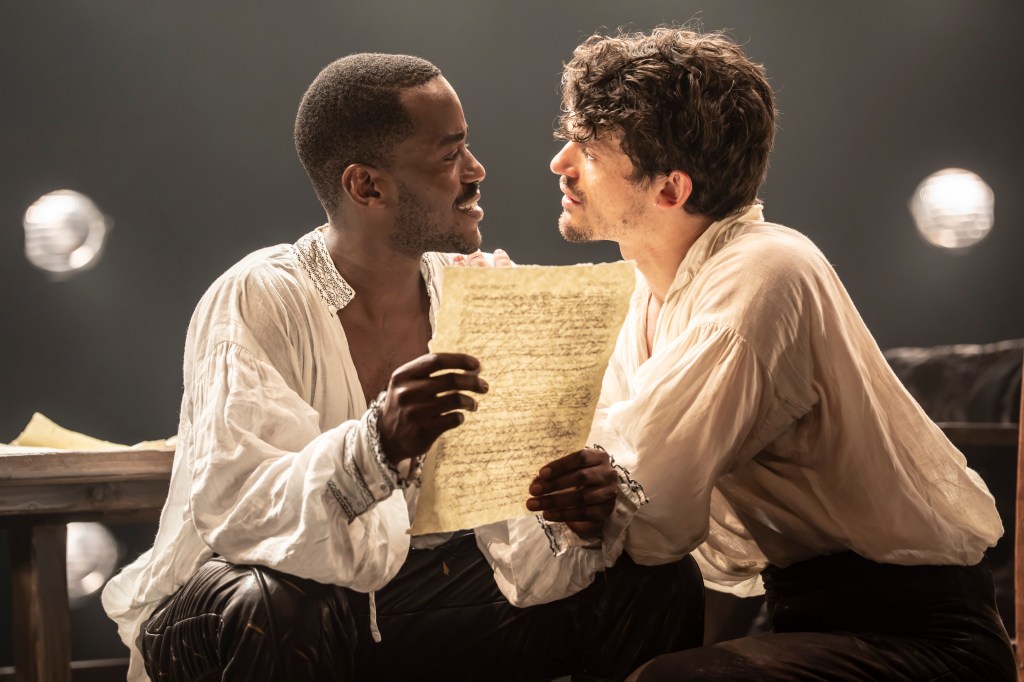
Born With Teeth, written by Liz Duffy Adams and directed by Daniel Evans, explores the hypothetical collaboration between Christopher Marlowe (Ncuti Gatwa) and William Shakespeare (Edward Bluemel) as they write Henry VI. But don’t come into the play expecting the facts – as Marlowe himself declares, “It’s theatre, it’s not a history lesson,” insisting that those pointing out historical inaccuracies simply need to have more sex.
From the opening scene, it’s clear that Adams is taking liberties with history and time, as the show begins with a bang and videos (designed by Andrzej Goulding) of Marlowe and Shakespeare screaming in what appears to be pain, before the two actors appear in a small hole in the digital screens, hanging from chains. But, only a few minutes after the thrilling opening, Shakespeare and Marlowe are found in a room in 1591 (told to us by neon green font on the digital screen), beginning the process of writing what will become known as the “first Henriad,” consisting of the three different parts of Henry VI.
From this point, the main characteristics of the two poets are established. Christopher Marlowe is at the top of his game, as proven by his elegant leather trousers and jacket (designed by Joanna Scotcher), a mix of modern and 16th-century fashion, and his excessively long quill, which he has a tendency to stroke for effect as he relentlessly flirts with Shakespeare, who has yet to become the beloved “Bard of Avon.” Instead, the audience is introduced to an up-and-coming poet who is just happy to be in the same room as Marlowe, someone he looks up to.
The two are finishing the work started by Thomas Nashe, who some academics have listed as one of the authors of Henry VI: Part One. While Shakespeare is happy to get paid to do some work, as there is not enough money in theatre (sound familiar?), Marlowe is less than pleased, focusing his attention on the other poet instead of their shared work, breezily establishing that “poets get around.” But Born with Teeth isn’t really focused on the actual writing of the first Henriad. Instead, audiences are brought into the world of 16th-century espionage, with Marlowe revealing to Shakespeare that he is one of the many spies under Queen Elizabeth I, working with Robert Cecil to weed out Catholics from England after the chaos under “Bloody Mary,” or Queen Mary I.
At first, Shakespeare refuses to become involved in this “secret world,” but Marlowe pulls him in, with Gatwa doing a fantastic job of playing the cocky and charming “leopard” to Bluemel’s unsure yet secretive “eel.” The two go from chasing each other around a table to making out on top of it, their internal battles continuing throughout the play. It appears to be a game of cat and mouse, but as the relationship between the two men grows, secrets are revealed that point to the playing field being more even than Marlowe may have originally believed.
Unfortunately, with all of the focus on spying and snogging, there is less of a focus on the actual writing of Henry VI, which is a shame, as there is plenty of potential for some great bits of dialogue between the two writers. There is a particularly interesting argument between Marlowe and Shakespeare about how to portray Joan of Arc, with Marlowe wanting her to be known as a whore and Shakespeare trying to illustrate the virtue of her martyrdom. So much more could have been explored by focusing on the writing process itself, as it could lead to discussions on subjects like religion and love that are present in the play.
Another strange aspect of the show is how it shifts between modern and Tudor times. Most of the dialogue could come straight from 2025, with Marlowe making comments like “There’s nothing I can’t ef” when discussing Shakespeare’s belief in ineffability, There are also several moments in which Shakespeare steps in front of the digital curtain and seemingly “pauses” the different play, letting the audience know which moments did and did not happen, as well as leaving some up to interpretation. With the runtime being just under ninety minutes, I would have liked to see more of a focus on the scenes themselves, though Bluemel does do an excellent job breaking the fourth wall in between dialogues with Gatwa. While the simple set (also designed by Scotcher) of tables and stools works, the incredibly bright lights surrounding the set (designed by Neil Austin) are headache-inducing, taking away from the play itself.
Fans of Shakespeare and Marlowe will be satisfied by the different references to their works, particularly the implications that several characters of Shakespeare are meant as a tribute to Marlowe himself – no spoilers! There are also throwaway references to other writers from that time period, including Fletcher and Beaumont, used to imply that other writers have similar relations as Marlowe and Shakespeare, using the excuse of being poor artists in London so they can live together without raising suspicion.
Ultimately, Born With Teeth is an interesting look at what may have happened behind closed doors between two of England’s most famous poets of the 16th century, but the reimagining of history leaves plenty to be desired. Gatwa and Bluemel both give fantastic performances, but there is not enough in the script to make it a play one can really sink their teeth into, whether on stage or watching from the audience.
Born With Teeth runs from 13 August to 1 November at Wyndham’s Theatre. For more information and to purchase tickets, click here.
 Little Lark of London
Leave a comment